
The Foundation for a Meaningful Life
Kindergarten - Grade 9 in Southborough, MA
Kindergarten - Grade 9 in Southborough, MA
News Detail - Magazine
Primary School Update: A Math Mindset
Primary School was buzzing with energy this past May as the Commons and Multi-Purpose Room were transformed into a math-themed carnival.
Primary School was buzzing with energy this past May as the Commons and Multi-Purpose Room were transformed into a math-themed carnival. Branded as "Math Mayhem," the event was hosted by Math Department Chair Maura Oare and Upper School math teacher Christina Berthelsen and brought to life by Upper School and sixth grade student volunteers. The afternoon successfully turned abstract mathematical concepts into hands-on fun as students rotated through a series of carnival-style challenges. The interactive games reinforced core math skills such as pattern recognition, estimation, and determining probability. Math Mayhem is just one example of how Primary School students are encouraged to discuss, question, and apply their math skills in real-world contexts, fostering deep engagement and building confidence for young mathematicians.
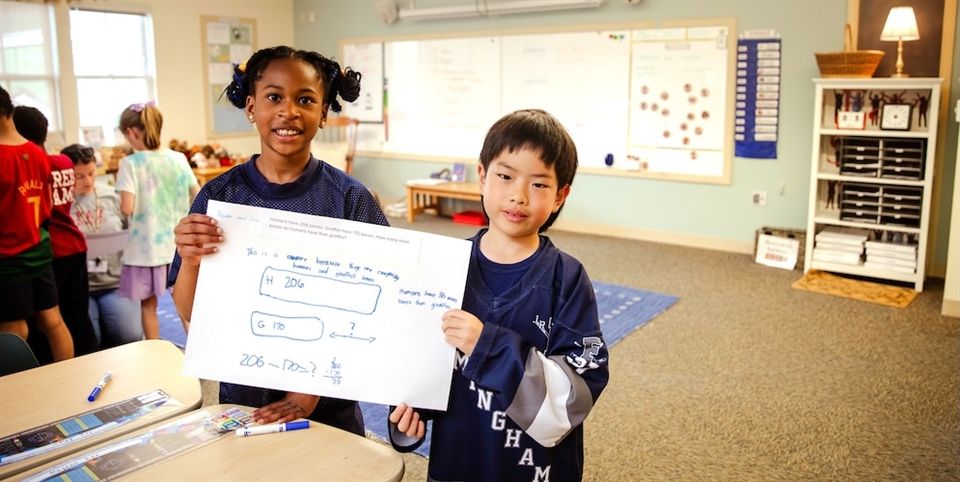
The focus on making mathematical thinking visible isn't just reserved for special events; it is built into the curriculum's foundation. Starting in Kindergarten, students are encouraged to strengthen their mathematical problem-solving skills during math warm-ups, where they tackle mental math problems as a group, share strategies, and defend their answers. They also decode word problems and write their own, a practice that builds fluency in translating numbers into language and back again. "One of the things that Primary School does really well is to train kids to write about their mathematical thinking, speak articulately about their thinking, and to provide the mathematical reasoning for their answer," says Maura. This approach builds confidence while exposing students to different problem-solving methods that expand their mathematical toolkits. First grade teacher Kelly Porter adds, "We always have the children share multiple strategies for solving the same problem, so they understand that another mathematician might approach a problem differently."
Building mathematical thinking is woven into the daily schedule in Primary classrooms. During morning meetings, first graders track the passing of the school year by updating the daily calendar count. As they add each day, they are encouraged to bundle groups of ten, a routine that builds a concrete understanding of place value, and calculate how many more days until the next milestone of ten, reinforcing addition and number sense. Every morning, second graders answer a question on the board, such as voting for their favorite season, recording their daily commute length, or their height. Using personalized face magnets, the class collaborates to transform these data points into a physical bar graph. This interactive exercise helps students analyze real-world information and recognize visual depictions of numbers. This spring, second graders carried those data skills into science class as they traced the growth of their bean plants. Instead of viewing math as an isolated subject, students used their graphing experience to gather real-time scientific data. "They're taking what they've already learned about interpreting data and graphs and applying it to science," notes second grade teacher Maggie Walter. "Obviously, science and math go hand in hand quite often, and this helps students to see that connection."
Students also develop their abstract reasoning through subitizing, the ability to instantly recognize the number of objects in a group without counting them individually. To practice, teachers flash groups of dots or dice images and ask students how many they saw. This exercise engages pattern recognition and early multiplication skills as students naturally group images together. "The students are tackling multi-step thinking and seeing how numbers group together, the very beginning of order of operations, right there in the earliest of grades," says Maura. In Kindergarten, students regularly tackle open-ended math challenges using educator Graham Fletcher's 3-Act Tasks. These video-based investigations hook students' interest with real-world scenarios, such as estimating how many candies roll out of a vending machine, and challenge students to find the solution. Similarly, second graders engage with "Esti-Mysteries," an activity where students use a series of numerical clues to narrow down an unknown number. To find the correct answer, students must apply deduction, estimation, and logical mathematical reasoning.
Math Mayhem transformed a regular afternoon into a festival of mathematical games, taking math off the page and into the realm of real-world problem solving. Students went bowling for numbers, adding and subtracting the point values of the pins they knocked down, and they balanced weighted scales to visualize the structure of an equation. Students categorized numbered rubber ducks floating in water by whether they were prime, composite, odd, or even, while other stations challenged them to estimate the number of items in a jar or calculate the probability that a spinner lands on a certain color. "The hands-on activities and playful challenges allowed students to experience probability firsthand," notes Maura, "bridging the gap between theoretical and experimental probability, and proving that abstract mathematical reasoning can be both accessible and fun for our youngest learners."

48 MAIN STREET
SOUTHBOROUGH, MA 01772
main number 508-490-8250
admission 508-490-8201
SOUTHBOROUGH, MA 01772
main number 508-490-8250
admission 508-490-8201


