
The Foundation for a Meaningful Life
Kindergarten - Grade 9 in Southborough, MA
Kindergarten - Grade 9 in Southborough, MA
Fay Magazine: Summer 2026
Upper School Update: Backyard Biodiversity
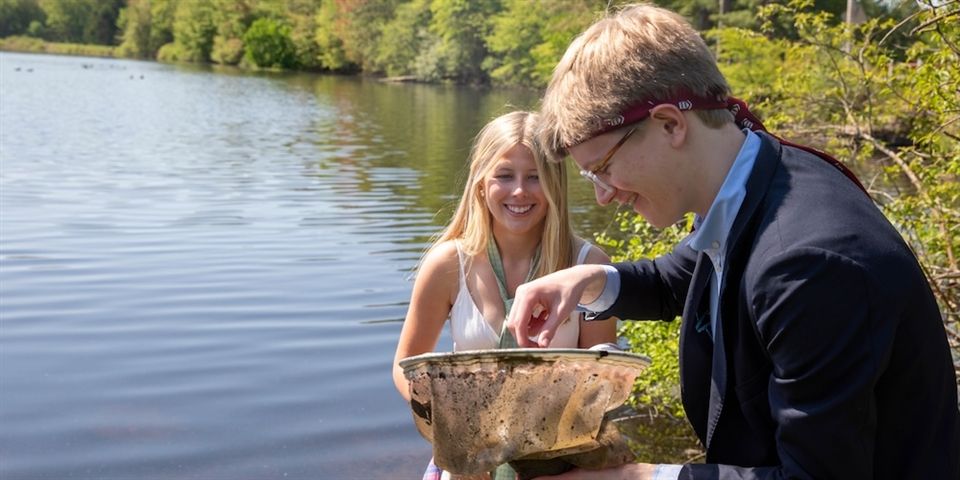
This spring, ninth grade biology students engaged in a hands-on science and service project focused on understanding and protecting local biodiversity.
This spring, ninth grade biology students engaged in a hands-on science and service project focused on understanding and protecting local biodiversity. Students learned about the importance of biodiversity to our environment, conducted biodiversity analyses at local field sites, researched the threats posed by invasive species, and designed educational resources for publication on the Southborough Conservation Commission's website.
The project was created by Upper School science teacher and Sustainability Coordinator Jenna Barbary-Glovsky, who, in addition to teaching biology, serves on the Town of Southborough's Conservation Commission. Through her work with the commission, she noticed that the town's website needed updated resources that could help educate the public about the local ecosystem and the importance of environmental laws such as the Wetlands Protection Act. Seeing a perfect opportunity for civic engagement, Jenna designed a project that would give her students a real-world lesson in the importance of biodiversity while providing an important service to the local community.
To lay the foundation, Jenna introduced core ecological concepts like population growth, invasive species, and environmental carrying capacity, helping students understand the vital role biodiversity plays in our lives. Her goal was to help students see why biodiversity is so important and that it has a tangible value. "The wetlands essentially do billions of dollars of ecosystem management for us," points out Jenna. "They're filtering our water, buffering floods, providing habitats, and doing all this work that we can attribute an actual monetary value to. It's a way for us to better understand how important they are to us as humans."
Next, the class conducted biodiversity sampling both on campus and at nearby Chestnut Hill Farm. Working in teams, students staked off a one-yard by one-yard site to study. They combed through the area, using the iNaturalist app to identify the plants, animals, and fungi they observed. To get as close to an accurate analysis as possible, the teams dug into the dirt to count every species present, while remaining mindful of the ecosystem's invisible occupants. "There are insects and fungi that live in the soil that we're not seeing," Jenna explains, "So we tried to really be thorough while also understanding that we weren't seeing the whole picture."
Students then turned their focus to localized research, spending two weeks investigating how biodiversity and invasive species impact Southborough specifically. Working in collaborative teams, they developed projects on a variety of topics, including removal tips for local invasive species, guidelines for sustainable fishing in the Sudbury Reservoir, the local impact of the destructive spotted lanternfly, the effect of campus construction on common area birds, and an analysis of biodiversity at Chestnut Hill Farm. As a final step, students compiled their research and created brochures or posters, using the skills they learned in their Advanced Design Portfolio or Creators classes to present their findings in a clear and compelling manner that would be easily understood by the average citizen. The Conservation Commission and Town of Southborough are developing these materials for broader distribution on the town website.
Looking ahead, Jenna hopes to expand this into a multi-year project that continues giving students valuable experience in field research and data collection. "We focus a lot on how to design an experiment in this class, gather samples, and analyze data in a way that yields information that you can't just look up online," Jenna says. "The long-term goal is to track the spread of invasive species over time on campus and across town properties. By comparing our campus data with sites that aren't as actively managed, future classes can build on this research, making it possible for the school and the town to build a better plan for managing invasive species."

48 MAIN STREET
SOUTHBOROUGH, MA 01772
main number 508-490-8250
admission 508-490-8201
SOUTHBOROUGH, MA 01772
main number 508-490-8250
admission 508-490-8201


