
The Foundation for a Meaningful Life
Kindergarten - Grade 9 in Southborough, MA
Kindergarten - Grade 9 in Southborough, MA
Fay Magazine: Summer 2026
Lower School Update: At Home in the World
This year, fifth grade world language students explored how homes reflect culture through a unique hands-on collaboration with the Principles of Design (POD) class.
You can learn a lot about a culture by walking through a traditional home, from the fabrics and colors to the materials used to construct the building and furnishings. This year, fifth grade language students explored this idea through a unique collaboration with Principles of Design (POD) class. In their world language classes, each student researched a country where the language they are studying is spoken. They learned about the style of traditional homes in that country, expanding their vocabulary and cultural understanding.
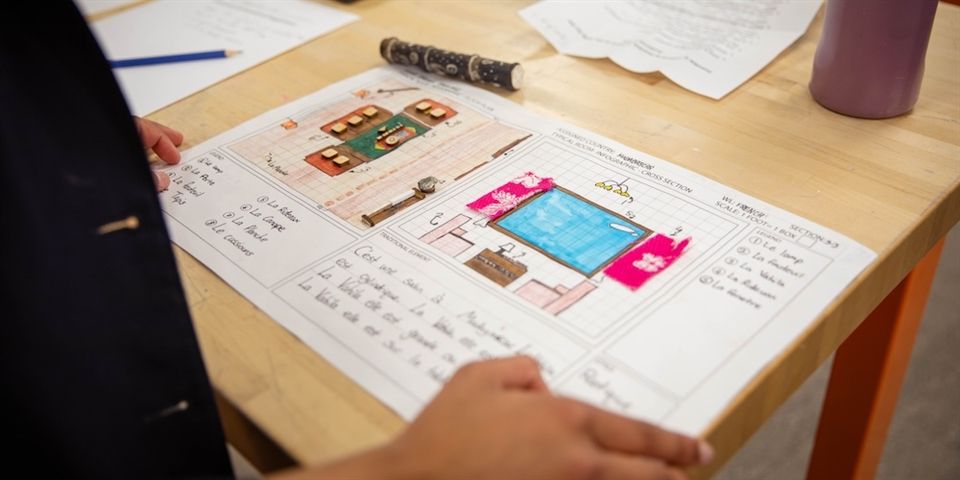
This spring, students applied those concepts in POD class, where they learned technical drawing skills to create floor plans and 2D cross-sections of homes in their French- or Spanish-speaking countries, from Cambodia and Morocco to Panama and Argentina. To give their projects a personal touch, students also used Makers Empire software to design and 3D-print a traditional cultural object that might be found inside their home.
During the winter term, students began researching the homes that are common in their assigned country. "For many of our students, 'home' means a house, but it's important to acknowledge that's not the case everywhere around the world," says World Language Department Chair Kara Mertz. Students researched home designs using a curated list of books in the library and some online resources, learning about a range of homes from tall wooden row houses in Belgium to Guatemalan homes fabricated from cornstalks. To prepare for the project, students learned vocabulary for homes and furniture, descriptive adjectives, and prepositions to explain where objects are located. Kara points out that this unit is particularly rewarding because many of the Spanish and French terms are cognates, enabling students to acquire a large amount of vocabulary quickly and easily.
As part of the project, students also researched an object authentic to the culture that they would later design and 3D-print in Makers Empire, writing about its significance, appearance, and where it might be found in a traditional home. Students practiced their speaking skills by presenting their projects to each other and reading aloud the paragraphs they wrote describing their homes' interiors.
Because design is inherently intentional, students also deepen their understanding of culture and language through this cross-curricular project by designing a home, complete with furnishings and authentic objects appropriate to their country. Each student brought the research and knowledge they had gained about their country to POD class, ready to focus on the aesthetic elements of home design in that culture. Students researched common architectural styles and the materials used in home construction, which are often native to the environment.
Design teacher Deborah Morrone-Bianco introduced students to technical drawing skills, teaching them how to create a top-down floor plan and a cross-section, each with a legend identifying the furnishings and key items in French or Spanish. "Students aren't drawing to scale yet, but each box on the paper represents one foot, and we asked them to keep things in proportion," says Deborah. Students added character to the technical drawings by incorporating textured 3D elements, such as wooden blocks, to represent seating. " Some of the students found fabric that looked like it was from their country and added curtains for the windows. They were excited, and it added a touch of fun," says Deborah. When it was time to create a 3D object in Makers Empire symbolizing their country's culture, they designed, printed, and painted everything from traditional Guatemalan worry dolls to a vejigante mask used in festivals in Puerto Rico.
Both pieces of the project came together seamlessly this spring when students hosted a gallery walk for the community and their families. Students proudly shared their technical drawings and 3D-printed objects, while visitors at each station scanned QR codes to view the designs inside Makers Empire. It was an impressive showcase of cross-curricular learning, giving students the chance to present all the components of their project and confidently share everything they had learned.

48 MAIN STREET
SOUTHBOROUGH, MA 01772
main number 508-490-8250
admission 508-490-8201
SOUTHBOROUGH, MA 01772
main number 508-490-8250
admission 508-490-8201


